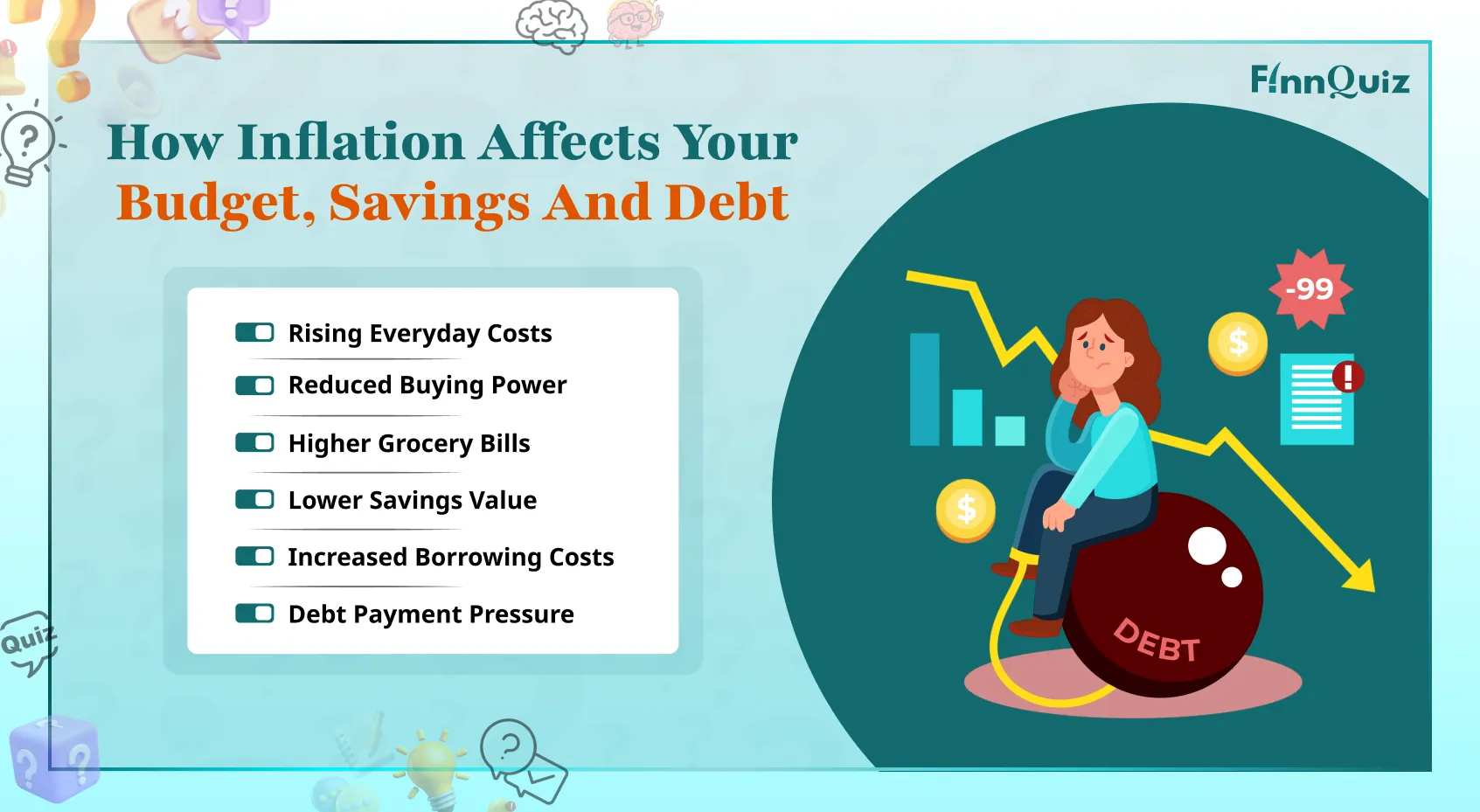
Inflation is the gradual rise in the cost of the overall package of things you buy in daily life: groceries, housing, gas, medical care, and education. It does not mean one specific price went up — it means the general cost of living is increasing. When inflation is 3%, a basket of goods that cost $100 last year costs $103 this year. Your money buys less over time. This guide explains how inflation affects your monthly budget, the real value of your savings, and the cost of your debts — and what you can do about it.
Three Inflation Measures Used in the Examples
- Inflation: The rate at which the general level of prices for goods and services rises, eroding purchasing power.
- Consumer Price Index (CPI): A measure of the average change over time in prices paid by urban consumers for a market basket of goods and services.
- Purchasing power: The real value of money — what it can actually buy. Inflation reduces purchasing power over time.
- Nominal return: The stated return on an investment or savings account before adjusting for inflation.
- Real return: The return after subtracting inflation. Real return = nominal return − inflation rate.
- Fixed-rate debt: A loan with an interest rate that stays the same for the entire term (e.g., most mortgages).
- Variable-rate debt: A loan with an interest rate that can change over time based on market rates (e.g., some credit cards, adjustable-rate mortgages).
Inflation and the Consumer Price Index (CPI)
The Consumer Price Index (CPI) is a widely used measure of inflation. The Bureau of Labor Statistics publishes it monthly, so the current 12-month rate must be checked in the latest BLS release. The calculations below use a hypothetical 3.5% rate to show the arithmetic; they do not claim that 3.5% is today’s inflation rate.
CPI is an average, while individual categories can move at very different rates. Your household’s experience depends on what you buy, where you live, and whether you substitute products when prices change. Use the current BLS category tables for current figures instead of reusing numbers from an older release.
How Inflation Affects Your Household Budget
When prices rise, your monthly budget stretches less. The groceries, rent, gas, and utilities you buy every month cost more than they did a year ago. If your income does not rise at least as fast as inflation, you are effectively taking a pay cut.
Hypothetical example: if a household’s exact basket rose by 3.5%, a $4,000 monthly basket would cost about $4,140, an increase of $140 per month or $1,680 per year. Real households change what they buy, and individual prices do not all rise by the same percentage.
Worked Household Example Using a Hypothetical Rate
This is a hypothetical example for illustration. The Garcia household has a monthly take-home income of $5,000. Their budget in 2025 looked like this:
- Rent: $1,600
- Groceries: $700
- Utilities (electric, gas, water): $250
- Gasoline: $200
- Car insurance: $120
- Health insurance: $400
- Phone/internet: $150
- Dining out: $300
- Entertainment: $200
- Clothing/personal care: $150
- Miscellaneous: $130
- Total: $4,200
- Left for savings: $800
For this illustration, assume the household’s overall basket increases by 3.5%. If it buys the same quantities, the example budget would look like this:
- Rent: $1,656 (+3.5%)
- Groceries: $725 (+3.5%)
- Utilities: $259 (+3.5%)
- Gasoline: $207 (+3.5% in this simplified illustration; actual fuel prices may move differently)
- Car insurance: $124 (+3.5% in this simplified illustration; an actual premium may move very differently)
- Health insurance: $414 (+3.5%)
- Phone/internet: $155 (+3.5%)
- Dining out: $311 (+3.5%)
- Entertainment: $207 (+3.5%)
- Clothing/personal care: $155 (+3.5%)
- Miscellaneous: $135 (+3.5%)
- Total: $4,348
Their savings would drop from $800 to $652 per month — a loss of $148 per month, or about $1,776 per year — if their income stayed flat. The Garcia household would need to either cut spending, earn more, or accept lower savings.
How Inflation Affects Your Savings
Inflation is the enemy of cash savings. Money in a checking or low-yield savings account loses purchasing power every year that inflation exceeds the interest rate.
Real return is the key concept: Real return = nominal interest rate − inflation rate. If your savings account earns 1% APY but inflation is 3.5%, your real return is negative 2.5%. You are losing purchasing power, even though your account balance is growing.
Example: $10,000 in a savings account earning 1% APY grows to $10,100 after one year. But with 3.5% inflation, goods that cost $10,000 at the start of the year cost $10,350 at the end. Your $10,100 buys less than your original $10,000 did. You have lost purchasing power.
How Inflation Affects Your Debt
Inflation affects borrowers and lenders differently depending on whether the debt has a fixed or variable interest rate.
- Fixed-rate debt (e.g., most mortgages, fixed-rate student loans, auto loans): Inflation can benefit borrowers. You repay the loan with dollars that are worth less than when you borrowed them. Your monthly payment stays the same, but its real value declines over time. This is one reason homeowners with fixed-rate mortgages often benefit from inflation.
- Variable-rate debt (e.g., credit cards, adjustable-rate mortgages, some personal loans): Inflation can hurt borrowers. Central banks often raise interest rates to fight inflation, which makes variable-rate debt more expensive. Your monthly payment can increase, straining your budget.
If you have high-interest variable-rate debt, such as credit card balances, inflation can make it even harder to pay down. The interest rate on your card may rise, and the dollars you use to pay it are worth less.
Comparison Table: How Inflation Affects Different People
| Person/Scenario | How Inflation Affects Them |
|---|---|
| Saver with cash in a low-yield account | Loses purchasing power — real return is negative |
| Borrower with fixed-rate mortgage | Benefits — repays with dollars worth less over time |
| Borrower with variable-rate credit card debt | Hurt — rates may rise, payments increase |
| Worker with wages not keeping up | Hurt — real income declines, budget tightens |
| Retiree on fixed income | Hurt — purchasing power erodes each year |
| Homeowner with fixed-rate mortgage and rising home value | May benefit — home value often rises with inflation |
Practical Ways to Adjust Your Budget for Inflation
- Track your spending: Know where your money goes each month. Awareness is the first step to control.
- Review subscriptions and memberships: Cancel anything you do not use regularly.
- Shop smarter: Use grocery lists, compare prices, buy store brands, and plan meals around sales.
- Reduce energy costs: Adjust your thermostat, unplug electronics, use LED bulbs, and consider a programmable thermostat.
- Negotiate bills: Call your internet, cable, and insurance providers to ask for better rates.
- Look for student, senior, or military discounts where applicable.
- Consider a side hustle or ask for a raise: If your income is not keeping up with inflation, explore ways to increase it.
- Review your insurance policies: Shop around annually to ensure you are not overpaying.
Personal Inflation Worksheet
| Category | Last Year's Monthly Cost ($) | This Year's Monthly Cost ($) | Percent Change (%) |
|---|---|---|---|
| Rent/mortgage | ___ | ___ | ___ |
| Groceries | ___ | ___ | ___ |
| Utilities | ___ | ___ | ___ |
| Gasoline/transport | ___ | ___ | ___ |
| Insurance | ___ | ___ | ___ |
| Phone/internet | ___ | ___ | ___ |
| Dining out | ___ | ___ | ___ |
| Entertainment | ___ | ___ | ___ |
| Other | ___ | ___ | ___ |
| Total | ___ | ___ | ___ |
Fill in the worksheet using your bank statements from the same month in consecutive years. Your personal inflation rate is the total percent change in your actual spending. It may be higher or lower than the national CPI.
Budget Adjustment Checklist
- Have I calculated my personal inflation rate using the worksheet above?
- Have I identified the categories where prices have risen the most?
- Have I looked for ways to reduce spending in those categories?
- Have I reviewed my subscriptions and canceled unused ones?
- Have I called my service providers to ask for better rates?
- Have I adjusted my thermostat and reduced energy usage?
- Have I considered a side hustle or asked for a raise?
- Have I reviewed my insurance policies for better rates?
- Have I updated my budget to reflect current prices?
Common Mistakes and Consequences
- Ignoring inflation: Assuming today's prices will stay the same can lead to severe under-saving for retirement and other long-term goals.
- Keeping all savings in cash or low-yield accounts: Inflation erodes purchasing power. Consider accounts or investments with returns that historically outpace inflation.
- Not negotiating salary: If your income does not at least keep up with inflation, your standard of living declines.
- Failing to review your budget: Without regular updates, your budget becomes outdated and unrealistic.
- Using variable-rate debt for long-term purchases: If rates rise, your payments can become unaffordable.
- Assuming the CPI reflects your personal experience: The national average may not match your spending patterns. Track your own inflation.
Important Exceptions and Limitations
Inflation does not affect everyone equally. If you own a home with a fixed-rate mortgage, inflation may benefit you by reducing the real value of your payments. If you are a renter, you may face rent increases that outpace the CPI. If you have significant credit card debt, rising rates can make your situation worse. The national CPI is an average; your personal experience will vary based on where you live and what you buy. Households with lower incomes tend to spend a larger share on necessities like food, housing, and energy, which are often the categories with the highest inflation.
Calculate Your Household’s Price Change
This week: complete the personal inflation worksheet using your bank statements. Next week: review your budget category by category and adjust for current prices. Identify one subscription to cancel or one bill to negotiate. This month: if your income has not kept up with inflation, consider asking for a raise or exploring a side hustle. Revisit your budget every quarter to keep it current.